is a BIG deal.
"Theory meets pragmatism meets optimism" - sounds like what architecture should be all about.
Yay for cool links shared among archis on mah newsfeed.

homesick
Showing posts with label architecture. Show all posts
Showing posts with label architecture. Show all posts
Sunday, June 6, 2010

Tuesday, May 25, 2010
Slowness, according to TWBTA
An excerpt from the essay "Slowness" on the Tod Williams Billie Tsien Architects website (it's great to have time to browse random firm websites)...
In the United States, the practice of architecture has come to rely on the computer. In offices the word efficiency is always mentioned, and in design schools the capability to create and rotate complex forms in space is lauded. So, with surprising speed, the tools of the hand are becoming extinct.
* clutch pencil, lead and lead pointer
*bunny bag
*pounce
* erasing shield
* lettering template
*soon to disappear
This is a lamentation for lost tools and a quiet manifesto describing our desire for slowness. We write not in opposition to computers- in fact we are in the midst of bringing them into our studio- but rather it is a discussion about the importance of slowness. We write in support of slowness.
“There is a secret bond between slowness and memory, between speed and forgetting. Consider this utterly commonplace situation: a man is walking down the street. At a certain moment, he tries to recall something, but the recollection escapes him. Automatically, he slows down. Meanwhile, a person who wants to forget a disagreeable incident he has just lived through starts unconsciously to speed up his pace, as if he were trying to distance himself from a thing still too close to him in time.
In existential mathematics, that experience takes the form of two basic equations: the degree of slowness is directly proportional to the intensity of memory; the degree of speed is directly proportional to the intensity of forgetting.”
Slowness Milan Kundera
Slowness of method
Our desire to continue to use the tools of the hand, even as we may begin to use the computer, has to do with their connection to our bodies. Buildings are still constructed with hands, and it seems that the hand still knows best what the hand is capable of doing. As our hands move, we have the time to think and to observe our actions. We draw using pencil and ink, on mylar and on vellum. When we make changes, they occur with effort and a fair amount of tedious scrubbing with erasers, erasing shields, and spit. We have to sift back through previous drawings and bring them to agreement. So, decisions are made slowly, after thoughtful investigation, because they are a commitment that has consequence. It is better to be slow.
We like to keep the stack of finished and unfinished drawings nearby so that the whole project can be reviewed easily. Their physical presence is evidence of work done, and a reminder of what there is to do. The grime that builds up from being worked over is poignant and satisfying. We see the history of the presence of our hand. To have the actual drawings in reach allows us to understand the project in a more complete and comprehensive way. In the buildings we design, we struggle to achieve a unity and sense of wholeness that can come from a balance of individual gestures within a larger and more singular container. The focus of a computer screen feels too compartmentalized and tight to see and understand the whole. And if every time a change is made, a new printout is made, there is the problem that the printouts are too clean. They don’t show the scrubbed and messy sections of erasure, so there is no evidence to indicate the history of the development of an idea. Crucial to creating wholeness is the understanding of the development of the idea.
Documentation is an aspect of architecture particularly interesting to me, especially after several of the freshman seminar speakers(namely Nonya, Eva, Prof. Jimenez, Casbo...I want my fresh sem sketchbook back!) presented a lot of preliminary hand-drawn sketches in their lectures. We definitely lose something valuable (and beautiful) when we abandon trace for CAD, although you can't ignore the million advantages to designing on the computer. I don't know what things are going to look like by the time I'm working in a firm, but I fully take to heart what Danny meant when he said not to forget about the pencil.
p.s. what the heck is a bunny bag?
In the United States, the practice of architecture has come to rely on the computer. In offices the word efficiency is always mentioned, and in design schools the capability to create and rotate complex forms in space is lauded. So, with surprising speed, the tools of the hand are becoming extinct.
* clutch pencil, lead and lead pointer
*bunny bag
*pounce
* erasing shield
* lettering template
*soon to disappear
This is a lamentation for lost tools and a quiet manifesto describing our desire for slowness. We write not in opposition to computers- in fact we are in the midst of bringing them into our studio- but rather it is a discussion about the importance of slowness. We write in support of slowness.
“There is a secret bond between slowness and memory, between speed and forgetting. Consider this utterly commonplace situation: a man is walking down the street. At a certain moment, he tries to recall something, but the recollection escapes him. Automatically, he slows down. Meanwhile, a person who wants to forget a disagreeable incident he has just lived through starts unconsciously to speed up his pace, as if he were trying to distance himself from a thing still too close to him in time.
In existential mathematics, that experience takes the form of two basic equations: the degree of slowness is directly proportional to the intensity of memory; the degree of speed is directly proportional to the intensity of forgetting.”
Slowness Milan Kundera
Slowness of method
Our desire to continue to use the tools of the hand, even as we may begin to use the computer, has to do with their connection to our bodies. Buildings are still constructed with hands, and it seems that the hand still knows best what the hand is capable of doing. As our hands move, we have the time to think and to observe our actions. We draw using pencil and ink, on mylar and on vellum. When we make changes, they occur with effort and a fair amount of tedious scrubbing with erasers, erasing shields, and spit. We have to sift back through previous drawings and bring them to agreement. So, decisions are made slowly, after thoughtful investigation, because they are a commitment that has consequence. It is better to be slow.
We like to keep the stack of finished and unfinished drawings nearby so that the whole project can be reviewed easily. Their physical presence is evidence of work done, and a reminder of what there is to do. The grime that builds up from being worked over is poignant and satisfying. We see the history of the presence of our hand. To have the actual drawings in reach allows us to understand the project in a more complete and comprehensive way. In the buildings we design, we struggle to achieve a unity and sense of wholeness that can come from a balance of individual gestures within a larger and more singular container. The focus of a computer screen feels too compartmentalized and tight to see and understand the whole. And if every time a change is made, a new printout is made, there is the problem that the printouts are too clean. They don’t show the scrubbed and messy sections of erasure, so there is no evidence to indicate the history of the development of an idea. Crucial to creating wholeness is the understanding of the development of the idea.
Documentation is an aspect of architecture particularly interesting to me, especially after several of the freshman seminar speakers(namely Nonya, Eva, Prof. Jimenez, Casbo...I want my fresh sem sketchbook back!) presented a lot of preliminary hand-drawn sketches in their lectures. We definitely lose something valuable (and beautiful) when we abandon trace for CAD, although you can't ignore the million advantages to designing on the computer. I don't know what things are going to look like by the time I'm working in a firm, but I fully take to heart what Danny meant when he said not to forget about the pencil.
p.s. what the heck is a bunny bag?
Thursday, May 13, 2010
My Architect: A Son's Journey
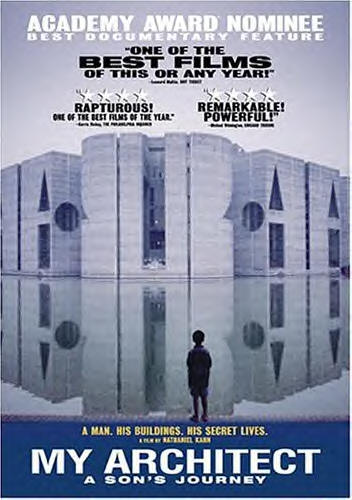
The life of the great architect Louis I. Kahn was in one word, as Umma would say, restless. This is a film made by Kahn's illegitimate son about his quest to find out who his father, internationally renown starchitect, hero to Bangladesh, the head of three different families, "ugly, short, and Jewish", ever enigmatic, ever elusive, truly was.
Lou Kahn's work is characterized by an unearthly heaviness and monumentality (explored in Alex Roman's must-see video: The Third & The Seventh, http://vimeo.com/7809605. full screen it!). With the little I know about the design process at this point of my career, I admire the simplicity and integrity of the servant-served concept carried out in his buildings. There is so much to be said about and to be learned from his work and philosophies.
That said, learning about the way he lives his life brings up the whole question of balancing architecture and life for me once again. Lou blatantly prioritized work over all else, his families, his health, people in general...he wouldn't even let people in his firm go home early to see their wives give birth if there was a rapidly approaching deadline.
As beautiful as the legacy he left through his buildings is, there is something terribly tragic about how he left behind little else for the people in his life. In my eyes, Lou was a human being who was always running away from one place to another, having an idea of what he valued but never resolutely committing to anything other than drawing and building and being incredibly hard-headed about his ideas.
I wonder where I will find myself in the next twenty years. If I have trouble balancing studio and life during the next five years, how will I balance work and life in the real world? Is it going to narrow down to either success in architecture or commitment to family/other relationships?
But I try not to worry too much about how tomorrow Hannah Lee will find a way to love God and care for people through work that I love but not treasure as much as the former two. We'll see. In the mean time, I'll concentrate on soaking up as much knowledge as possible. I'm stoked for interning and the watercolor class and for my summer reading list.
For the record, I think the film deserved the Academy Award nomination and would highly recommend it to anyone interested in Louis I. Kahn, or architecture, or life.
Subscribe to:
Posts (Atom)